Showing posts with label nostalgia. Show all posts

Wednesday, 20 April 2011

It's Official


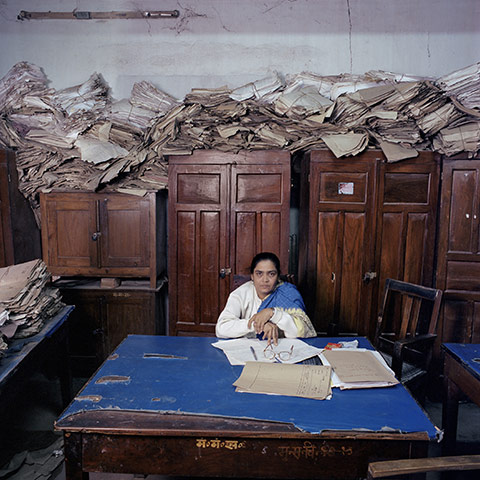
I couldn't help but notice this on the Guardian's website the other day: the Dutch photographer Jan Banning, has published a book, Bureaucratics which profiles portraits of public officials around the world.

This one attracted my attention: the piles of old papers dumped on the filing cabinets, the tatty desk, an overwhelming sense of the sheer pointlessness of it all. Most of the bureaucrats depicted are in mundane roles, such as town clerks, notaries or local police officials. They have to deal with members of the public. State symbols, such as flags, coats of arms, portraits of the founding fathers or current presidents line the walls of the offices. Desks are littered with stationery obviously, the occasional desktop PC or laptop, and all sorts of bric a brac. The offices are usually plainly decorated as you would expect public buildings to be.

I work as a civil servant and found that I related to many of the people in these pictures. I would take a photo of my office if I could, but my employer forbids photography on the site. Needless to say the open-plan office I work in is as dull as any of these places. Although officially, as a Crown servant, I work for the Queen, not the government, there are no portraits of Her Majesty on the wall. Sometimes the Union Jack is flown from the flagpole outside, but not every day. A visitor would be hard-pressed to know that this was a government building (except perhaps for the peeling paint on the walls). The buildings are old, but the furniture and equipment is modern, and I spend all day using a PC. Many of the old trappings of officialdom are out of use; for example it has been years since I filed a document in paper form, or stamped a document. In a way, I miss the old fashioned office ways. In my first job in the civil service, I was a clerk and had to do all those things: typing out documents, obtaining signatures, stamping them, filing them. I will have to post some more reminiscences of those days, which, despite being less than twenty years ago, feel a lifetime away.

In some months, my job will relocate to a nearby large city, and I'll be working in a modern office building. The move will mark the end of an era; I'll be coping with a longer commute and alternative working patterns and doing everything electronically. In the office there's a box full of redundant rubber stamps. I hope I can rescue them for posterity if not actually get to use them officially.

Friday, 4 March 2011

In Search of the Elusive Crackerjack Pencil

(Thanks to TV Cream for this cap)

Most of this post will be meaningless to anyone not from the UK, or under the age of 40. But then again...

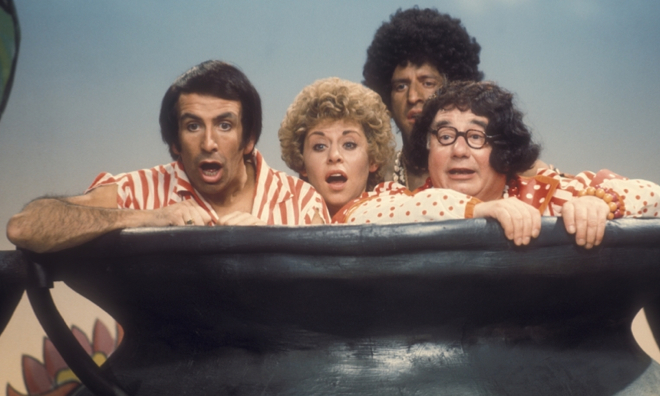
Crackerjack was a children's entertainment television programme made by the BBC. It ran for nearly 30 years from 1955 until December 1984 and had a "variety" format where pop music and short comedy sketches were punctuated by competitions for members of the audience. As that audience was made entirely of schoolchildren, you can imagine how frenetic each show could be. It was rooted in England's music hall tradition and even in the 1950s must have seemed old-fashioned. (It certainly was when I watched it in the 1970s - see below.)


Inevitably, as with all competitions, there were winners and losers. Winners would be showered with games, toys and trinkets. Losers would receive a Crackerjack pencil, which was the idea of the show's producer, John Downes.

And it was only by losing at those games that you would obtain a Crackerjack pencil. Unlike the common Blue Peter badge, the supply of Crackerjack pencils was very tightly controlled. One (probably apocryphal) story has it that a BBC executive asked for one and was turned down flat, though the BBC did not turn the Queen down when she asked for some!

Since 1984, no new pencils have been given away. I've often wondered if there are any Crackerjack pencils left in the wild: perhaps as a stub languishing in a drawer somewhere, or someone's prize souvenir of their 60 seconds of fame. I've tried in vain to search for a picture of one, but Google Images gives me only pictures of a Cracker Jack Pencil Topper, which is not the same thing at all. Sometimes people put out plaintive requests on the internet for one. One of these things would command an astronomical price if it were to be put on the market - perhaps not as much as an original Thoreau pencil, but not far off. The Crackerjack Pencil is a culturally significant object to many adults here in the UK, an elusive butterfly, a reminder of lost youth.

(If you have one handy, let me know and I'll give you a fiver for it.)

Thursday, 24 February 2011

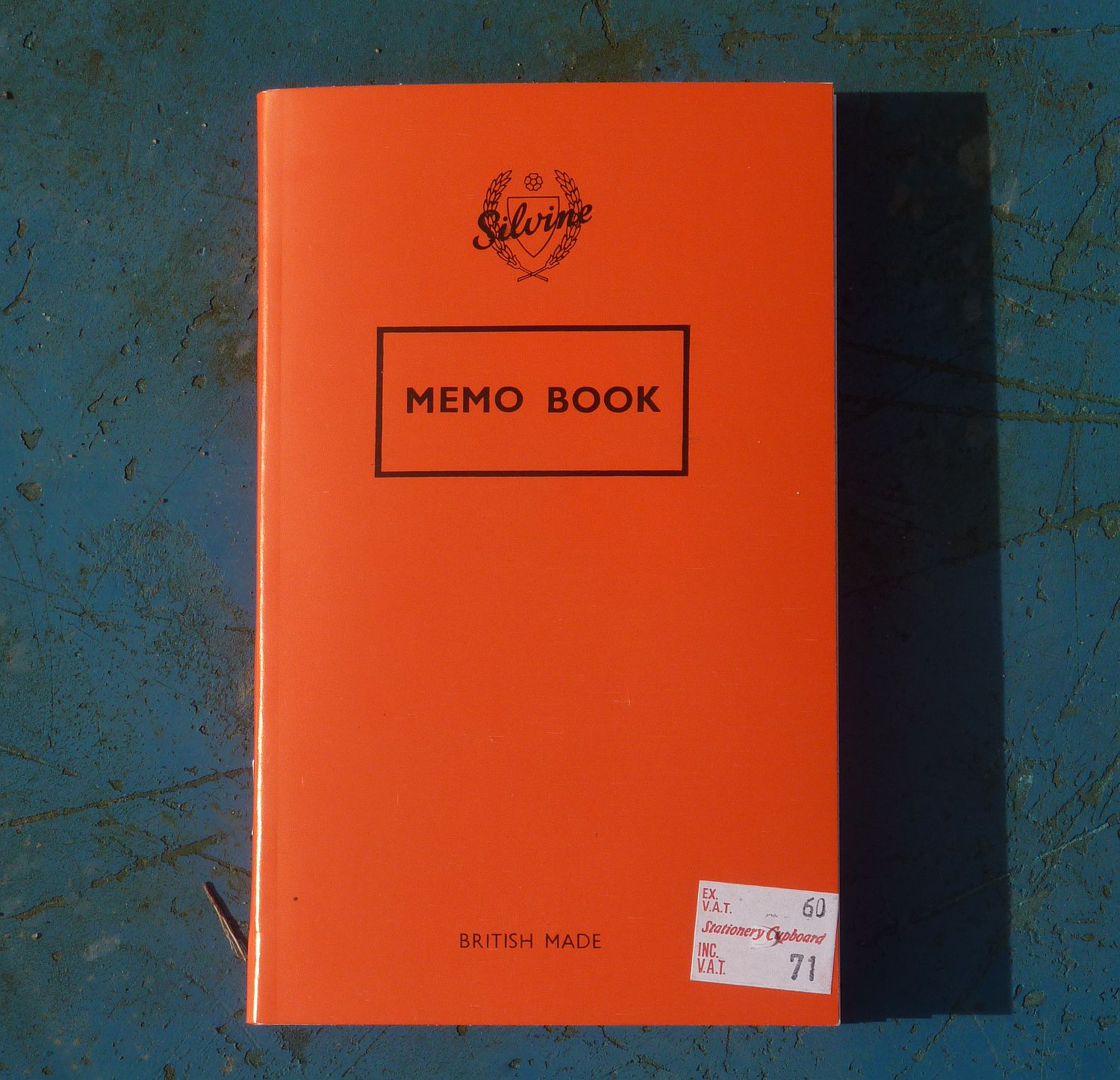
Silvine Memo Book


This post about indexing, by the miserablist “Nemo” on the Mobilis Ink Mobili blog, reminded me of the existence of the Silvine brand of stationery, which has been a staple of British newsagents’ stationery shelves for years. I remember that often, they were the only affordable notebooks available in the local Lavells or Martins in the days before Moleskine. Established in 1901, the Silvine brand is owned by the Sinclair company, based in Otley, West Yorkshire. Silvine is one of the few British stationery brands left in operation, but seems to be run on 21st Century lines: for example, it boasts ISO 14001 and FSC certification. Silvine’s red jackets stood out a mile and their Memo Books were commonly used for all kinds of quotidian jobs: shopping lists, to-do lists, aircraft spotters’ lists of airliner registrations, and so on. Silvine was never seen as a premium brand; it was just an everyday brand of stationery.

Recently,I popped into the local stationer’s and picked up two of Silvine’s classic products: the Exercise Book, and the aforementioned Memo Book.


It's been many years since I used one of these: and the quality is surprisingly good. It has 72 pages, and measures a firmly pocket-sized 158mm tall by 99mm wide. On the cover it proudly proclaims that it is "BRITISH MADE". It is also very cheap at GBP0.71, or just over one USD. The cover is flimsy, but the paper is fine to write on. I used a variety of fountain pens, pencils and different Stabilo Point 88 felt-tip pens, and found that there was only minor bleed-through on one of my pens, the Pilot M90, which for this test was loaded with Diamine Imperial Blue ink. There was no discernible feathering where I've written with the fountain pens. See below for the results:


The paper is feint ruled - I don't believe they produce either plain or squared versions - and comes in a cash-book variant as well. In 2008, Silvine changed the brand logo: the one pictured above is the old one, which I prefer. Its replacement is just the name, without the laurel wreath, in a serif font.

This is a cheap, handy-sized little memo book with no frills at all. With a bit of care, it could be a constant companion on shopping trips, or even a trip to the local airport for a bit of aircraft spotting, like this for example:


Saturday, 1 January 2011

Happy New Year

Happy New Year!  I hope 2011 is an improvement over its predecessor.

This time of year has special significance to me.  My parents were from Scotland, where New Year celebrations are taken very seriously - it is called Hogmanay and you can read about it here. Every Hogmanay my parents hosted a party which began at midnight; much of New Year's Eve was spent cleaning the house before the party (a custom which I understand is also followed by the Chinese).  The post-party clean-up would occur once people had recovered from the festivities.  January is a month of looking forward: the nights begin to shorten again after the dark months of November and December, and the Christmas break is over.  I've done very little other than eat and drink too much this Christmas as I have been unwell, but the enforced break has allowed me to recharge my batteries; I'm even looking forward to getting back to work next week.

During 2011, I intend to continue posting from time to time on pencils and pens, with the occasional foray into typewriters and other subjects.  I intend to post one or two typecasts from the Olympia SM3 once I can work out how to darken the text on scans, or obtain a replacement ribbon.  There are some pencils I have yet to try - still no Blackwings or Dixon Ticonderogas here for example, though the latter is now available at Cult Pens - so perhaps I can get my hands on those, even with the rise in VAT due on Tuesday.

So, here's to the new year, and a new decade in stationery.  Again, Happy New Year!

Wednesday, 10 November 2010

Looking for The Perfect Shorthand Notebook

Years ago, in an earlier job in the civil service, I had a shorthand notebook which was just about perfect. It was made by HMSO (Her Majesty's Stationery Office - now called The Stationery Office after privatisation in 1996). In all senses this was a conventional shorthand notebook: it was wire-bound, and had feint lined paper. But the reason I liked it, was this: it had thick cardboard covers, with a hole cut into each, near the bottom. When the covers were turned inside out, and a 8cm treasury tag attached to brace them, it could be stood up to enable the typist to read what they had written whilst typing the text on a PC. I particularly liked this function, but also the light-blue cardboard front cover. The cardboard used was robust so it could be used anywhere dry and could withstand a battering in the briefcase.

Recently, I have been looking around for a similar shorthand notebook but to no avail. Most have the thick cardboard back cover, but the front cover is usually a thin sheet of glossy paper which simply is not robust enough to be used as a stand for anything at all. Even Clairefontaine's version is not up to spec (though the paper is as nice as ever).

If anyone could point me in the direction of a shorthand notebook which is similar to that old HMSO notebook, I'd be grateful for the information. I only wish now I'd ordered a few more and created a stash of them.