Readers (May I use the plural? Oh, alright then) might notice that the page view counter and the "defunct" blogroll are no more. I've been thinking of simplifying the layout of this blog for a little while, and neither seemed fit for purpose. After all, who wants to see a list of dead links and moribund blogs, or an odometer count?* So I've binned both of them. I will probably use the space to lengthen the blogroll and tinker around the edges. As always, the focus will be on blogging about my exploits in the world of stationery and "dead" media.
*That is a rhetorical question, by the way.

Wednesday, 11 May 2011

Tuesday, 10 May 2011
"New" Typewriter
The other day I picked up a new typewriter which I had won in an auction on eBay. It's a Brother Deluxe 1350, which I bought for GBP4.99. The low price is due to it being sold as pick-up only, and as it wasn't far from my home, I thought it was worth a punt.
I've had a quick turn on it, and taken a few photos which I do not have the time to upload just at the moment, and it's a lovely machine. I'm delighted with it, especially when I see that a similar typewriter sold for GBP37. It seems to have a nice, smooth action, and although I have not mastered all the keys yet, I hope to shortly. I particularly like the fake wood panelling on the front, which reminds me of the fake wood on old American station-wagons (here in the UK we had real wood on our cars). The font is a standard "Elite" typewriter font, but I'm no expert on these matters (I'm trying to find out more about different fonts). My wife is already concerned that I may get fixated on amassing a large collection of typewriters, but in fact I only want a few more (at least I tell myself this). If I could get hold of a nice script-font model, an Olivetti Lettera 22/32 cheaply and one with a Techno Pica typeface, I'd be happy...for a while, at any rate.
Another feature on this Brother is the fact that a previous owner, who I guess must have been a student, stuck a number of football stickers on the side. Apart from the team's sticker (Manchester United) there are stickers of a few players from the team which won everything in sight around the turn of this century: Ole Gunnar Sokskjaer, Ryan Giggs and Peter Schmeichel . I found this amusing, because Brother were the shirt sponsors for United's local rivals Manchester City in the 1990s.
Back to stationery: on eBay, as in football, you win some and you lose some. I had bid on a printing set but I was unsuccessful this time around. I'll keep looking.
Another typecast to follow soon...
I've had a quick turn on it, and taken a few photos which I do not have the time to upload just at the moment, and it's a lovely machine. I'm delighted with it, especially when I see that a similar typewriter sold for GBP37. It seems to have a nice, smooth action, and although I have not mastered all the keys yet, I hope to shortly. I particularly like the fake wood panelling on the front, which reminds me of the fake wood on old American station-wagons (here in the UK we had real wood on our cars). The font is a standard "Elite" typewriter font, but I'm no expert on these matters (I'm trying to find out more about different fonts). My wife is already concerned that I may get fixated on amassing a large collection of typewriters, but in fact I only want a few more (at least I tell myself this). If I could get hold of a nice script-font model, an Olivetti Lettera 22/32 cheaply and one with a Techno Pica typeface, I'd be happy...for a while, at any rate.
Another feature on this Brother is the fact that a previous owner, who I guess must have been a student, stuck a number of football stickers on the side. Apart from the team's sticker (Manchester United) there are stickers of a few players from the team which won everything in sight around the turn of this century: Ole Gunnar Sokskjaer, Ryan Giggs and Peter Schmeichel . I found this amusing, because Brother were the shirt sponsors for United's local rivals Manchester City in the 1990s.
Back to stationery: on eBay, as in football, you win some and you lose some. I had bid on a printing set but I was unsuccessful this time around. I'll keep looking.
Another typecast to follow soon...
Saturday, 7 May 2011


Thursday, 5 May 2011
"Alternative" Uses for a Pencil 2
No pictures this time, but today I used a pencil to mark a ballot paper at my local polling station. Today is an election day in much of the United Kingdom, with national government elections in Scotland, Wales and Northern Ireland, and local authority elections in England. I voted in none of those; instead I voted in a referendum held concurrently, the first referendum held across England since 1975.
The referendum was to vote on whether or not to introduce a new voting system in Parliamentary elections. I won't go into the details of our electoral system but the choice was between retaining the current First Past the Post system and introducing an Alternative Vote system.
Readers may be slightly surprised to see that the voting process in Britain is still very simple. I mark the ballot with a pencil according to my preference with an X in the box. And that's it. No machines are used in the count; we still employ teams of people to count the votes at town halls across the land.
So there's your alternative use for a pencil: democracy. Not bad for a cheap HB stub on a bit of string....incidentally I voted for AV.
The referendum was to vote on whether or not to introduce a new voting system in Parliamentary elections. I won't go into the details of our electoral system but the choice was between retaining the current First Past the Post system and introducing an Alternative Vote system.
Readers may be slightly surprised to see that the voting process in Britain is still very simple. I mark the ballot with a pencil according to my preference with an X in the box. And that's it. No machines are used in the count; we still employ teams of people to count the votes at town halls across the land.
So there's your alternative use for a pencil: democracy. Not bad for a cheap HB stub on a bit of string....incidentally I voted for AV.
Wednesday, 4 May 2011
Carved in Rubber
Apologies for the light blogging, I've been a bit busy lately. Despite a near-fortnight off work thanks to the fortunate conjunction of public holidays here in England recently, I've been gardening and decorating, and too tired to blog...
Recently I've become interested in another weapon in the stationer's arsenal: the humble rubber stamp. It started off a few years ago when I picked up a cheap self-inking rubber stamp kit from my local branch of Lidl. It is the sort which is a tabula rasa: a blank slate onto which you put your own message. Rather predictably I put my name, address and telephone number on it. I used it a few times, and then put it away in the desk and forgot about it until recently. When I dusted it off the other week, the ink pad had dried out, and my efforts to re-ink it with a bottle from my local unnamed stationers were unsuccessful.
I bought a Colop date stamp from the stationers, but I really wanted an address stamp, so eventually and after much procrastination I ordered one from customstampsonline.com. I used their online stamp designer, and had a traditional rubber stamp made up, the sort which requires a separate ink pad. It's very good indeed and I'm delighted with it. I've already used the new stamp on correspondence and for putting my name and address on various books in my library. I hope you don't mind, but I don't wish to show it here as, even though I don't hide my name on this blog, I don't want my home address plastered all over the internets. Needless to say if I send you a letter or card, you'll see it!
Now that I have my fine new stamp, I was left with a redundant self-inker, albeit one I need to use with the ink pad. What to do? Another recent interest of mine is in mail art and stamping, after stumbling across this website from Fluxus mail artist Ruud Janssen from Breda in the Netherlands, who curates an archive of rubber stamps. With a bit of work in swapping the letters and numbers around, my old stamp could now have a new purpose, and reproduce any slogan I wanted. Again I chose the obvious message, and here it is in all its inky glory:
 I suspect I will change it in time, however. One candidate for the space is one of my favourite quotes, from an old Prefab Sprout song, "Couldn't Bear to be Special":
Recently I've become interested in another weapon in the stationer's arsenal: the humble rubber stamp. It started off a few years ago when I picked up a cheap self-inking rubber stamp kit from my local branch of Lidl. It is the sort which is a tabula rasa: a blank slate onto which you put your own message. Rather predictably I put my name, address and telephone number on it. I used it a few times, and then put it away in the desk and forgot about it until recently. When I dusted it off the other week, the ink pad had dried out, and my efforts to re-ink it with a bottle from my local unnamed stationers were unsuccessful.
I bought a Colop date stamp from the stationers, but I really wanted an address stamp, so eventually and after much procrastination I ordered one from customstampsonline.com. I used their online stamp designer, and had a traditional rubber stamp made up, the sort which requires a separate ink pad. It's very good indeed and I'm delighted with it. I've already used the new stamp on correspondence and for putting my name and address on various books in my library. I hope you don't mind, but I don't wish to show it here as, even though I don't hide my name on this blog, I don't want my home address plastered all over the internets. Needless to say if I send you a letter or card, you'll see it!
Now that I have my fine new stamp, I was left with a redundant self-inker, albeit one I need to use with the ink pad. What to do? Another recent interest of mine is in mail art and stamping, after stumbling across this website from Fluxus mail artist Ruud Janssen from Breda in the Netherlands, who curates an archive of rubber stamps. With a bit of work in swapping the letters and numbers around, my old stamp could now have a new purpose, and reproduce any slogan I wanted. Again I chose the obvious message, and here it is in all its inky glory:
 I suspect I will change it in time, however. One candidate for the space is one of my favourite quotes, from an old Prefab Sprout song, "Couldn't Bear to be Special":
All words are trains for moving past what really has no name
Which fits in nicely with another element of mail art which interests me, that of asemic writing. Whilst writing this post, it struck me that this entire blog post is probably meaningless, a collection of words with no content or message at all. Oh, the futility. But then, I remembered the tabula rasa. So I leave it to you, Dear Reader, to impose your own interpretation on it...
Wednesday, 20 April 2011
It's Official
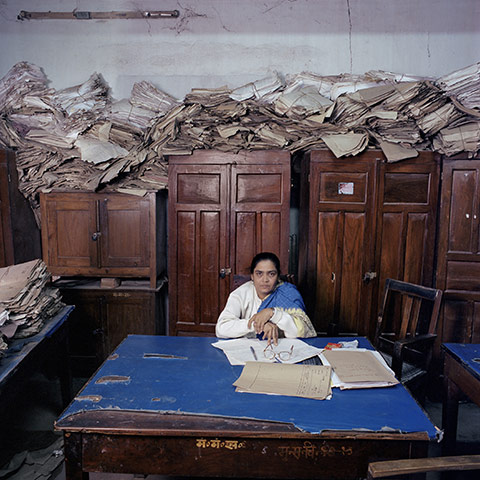
I couldn't help but notice this on the Guardian's website the other day: the Dutch photographer Jan Banning, has published a book, Bureaucratics which profiles portraits of public officials around the world.
This one attracted my attention: the piles of old papers dumped on the filing cabinets, the tatty desk, an overwhelming sense of the sheer pointlessness of it all. Most of the bureaucrats depicted are in mundane roles, such as town clerks, notaries or local police officials. They have to deal with members of the public. State symbols, such as flags, coats of arms, portraits of the founding fathers or current presidents line the walls of the offices. Desks are littered with stationery obviously, the occasional desktop PC or laptop, and all sorts of bric a brac. The offices are usually plainly decorated as you would expect public buildings to be.
I work as a civil servant and found that I related to many of the people in these pictures. I would take a photo of my office if I could, but my employer forbids photography on the site. Needless to say the open-plan office I work in is as dull as any of these places. Although officially, as a Crown servant, I work for the Queen, not the government, there are no portraits of Her Majesty on the wall. Sometimes the Union Jack is flown from the flagpole outside, but not every day. A visitor would be hard-pressed to know that this was a government building (except perhaps for the peeling paint on the walls). The buildings are old, but the furniture and equipment is modern, and I spend all day using a PC. Many of the old trappings of officialdom are out of use; for example it has been years since I filed a document in paper form, or stamped a document. In a way, I miss the old fashioned office ways. In my first job in the civil service, I was a clerk and had to do all those things: typing out documents, obtaining signatures, stamping them, filing them. I will have to post some more reminiscences of those days, which, despite being less than twenty years ago, feel a lifetime away.
In some months, my job will relocate to a nearby large city, and I'll be working in a modern office building. The move will mark the end of an era; I'll be coping with a longer commute and alternative working patterns and doing everything electronically. In the office there's a box full of redundant rubber stamps. I hope I can rescue them for posterity if not actually get to use them officially.
Tuesday, 12 April 2011
Pencil Spotting 1
Watching Neil Oliver's series "The Age of Iron" on BBC2 the other evening, I could not help but notice another Staedtler user:

This is Steve Brooks of the Natural History Museum. He is a research entomologist who researches climate change from midge larvae found in lake bed sediments.

Whilst he counts Chironomid midge larvae in the eyepiece of his microscope, I count one pencil with distinctive black and red stripes, white band and black end-cap.
 These Staedtlers can be found everywhere - in the laboratory, and perhaps even in ancient lakebed sediments.

This is Steve Brooks of the Natural History Museum. He is a research entomologist who researches climate change from midge larvae found in lake bed sediments.

Whilst he counts Chironomid midge larvae in the eyepiece of his microscope, I count one pencil with distinctive black and red stripes, white band and black end-cap.
 These Staedtlers can be found everywhere - in the laboratory, and perhaps even in ancient lakebed sediments.
Subscribe to:
Posts (Atom)